
A new roof is supposed to buy peace of mind.
Fresh shingles. Clean lines. Manufacturer warranties that promise decades of protection. For many Waterbury homeowners, a roof replacement feels like a once-in-a-generation investment.
Yet at LCM Services LLC, we regularly inspect roofs that are far too new to be failing — sometimes only five to eight years old — already showing signs of leaks, material breakdown, and structural stress.
The problem isn’t always bad shingles.
And it’s not always careless workmanship.
In Waterbury homes, new roof installations often fail early because critical factors are overlooked during planning and installation — factors that don’t show up in marketing brochures or basic estimates.
This article explains why that happens, what most contractors miss, and how homeowners can avoid repeating the same costly cycle.
A “New Roof” Doesn’t Automatically Mean a Protected Home
Many homeowners assume that replacing shingles equals replacing the roof.
In reality, a roofing system is far more complex. It includes:
- Decking
- Underlayment
- Ice and water barriers
- Flashing systems
- Ventilation
- Drainage paths
When even one of these elements is improperly designed or installed, the roof may look new — but function like an aging system.
In Waterbury’s climate and housing stock, that distinction matters.
Waterbury Homes Present Unique Roofing Challenges
Roofing methods that work well in newer developments or warmer regions often fail prematurely here.
Waterbury homes commonly feature:
- Older framing methods
- Uneven roof decks
- Limited attic ventilation
- Previous roof layers or repairs
- Decades of weather exposure
Installing a new roof without addressing these underlying conditions is one of the biggest reasons failures happen early.
What “Early Roof Failure” Actually Looks Like
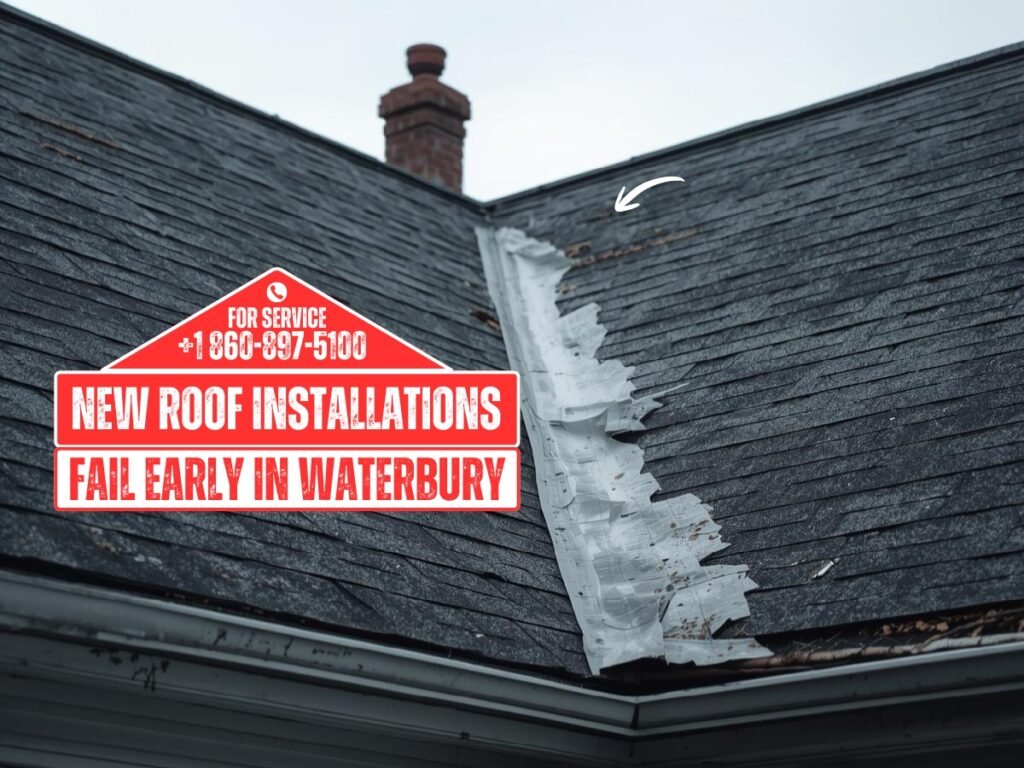
Early failure doesn’t usually mean shingles blowing off in year one.
It shows up quietly:
- Granules collecting in gutters
- Subtle shingle lifting
- Flashing separation
- Small ceiling stains
- Drafts or temperature swings upstairs
These are not cosmetic issues. They’re warnings that the system beneath the shingles is already stressed.
Mistake #1: Installing Over Old or Compromised Roof Decking
One of the most common shortcuts is reusing roof decking that should be repaired or replaced.
Older Waterbury homes often have decking that:
- Has absorbed moisture over time
- Has softened around fasteners
- Is uneven due to settling
New shingles installed over compromised decking never sit properly. This leads to:
- Improper sealing
- Fastener movement
- Accelerated shingle wear
A roof is only as strong as what it’s attached to.
Mistake #2: Minimum Ice & Water Shield in a High-Risk Climate
Manufacturer guidelines often specify minimum coverage for ice and water protection.
In Waterbury, minimum coverage is rarely sufficient.
Freeze–thaw cycles, snow accumulation, and ice dams push water upward — not downward — under shingles.
When ice and water shield coverage is limited:
- Water backs up under shingles
- Decking absorbs moisture
- Leaks appear far from the original entry point
This is a hidden failure that develops slowly but spreads aggressively.
Mistake #3: Ignoring Attic Ventilation During Roof Installation
Ventilation is one of the most misunderstood roofing components.
Many contractors focus only on exterior materials, leaving attic conditions unchanged. In Waterbury homes, this is a costly oversight.
Poor ventilation causes:
- Heat buildup in summer
- Condensation in winter
- Moisture damage from below
Over time, this leads to:
- Curling shingles
- Mold growth
- Weakened roof decking
A new roof installed over a poorly ventilated attic will age faster — regardless of shingle quality.
Mistake #4: Flashing Treated as an Afterthought
Flashing is where most roof leaks originate.
Common failure points include:
- Chimneys
- Roof valleys
- Skylights
- Roof-to-wall intersections
In many early roof failures, flashing issues are not material defects — they’re installation shortcuts.
Examples include:
- Reusing old flashing
- Improper sealing
- Incorrect overlaps
- Skipping step flashing altogether
These mistakes don’t fail immediately. They fail after repeated exposure to wind-driven rain and temperature changes.
Mistake #5: Layering Over Past Roofing Problems
Some Waterbury homes have been re-roofed multiple times without fully removing previous issues.
This can hide:
- Old water damage
- Structural weaknesses
- Improper drainage paths
When new roofing is layered over unresolved problems, the clock starts ticking from day one.
The roof may look new, but the failure path already exists.
Mistake #6: Assuming All Shingles Perform the Same Locally
Not all roofing materials respond equally to Waterbury’s weather.
Factors like:
- UV exposure
- Temperature swings
- Snow load
- Humidity
affect materials differently.
Choosing shingles based only on appearance or warranty length — without climate suitability — often leads to premature aging.
Local material selection matters.
Mistake #7: Drainage and Roof Geometry Overlooked
Roof design affects how water and snow move.
Common problems include:
- Valleys that trap debris
- Inadequate slope transitions
- Poorly placed gutters
When drainage isn’t carefully planned, moisture lingers where it shouldn’t — accelerating wear.
How Early Roof Failures Usually Develop
Here’s how the process typically unfolds:
| Stage | What Happens |
| Year 1–2 | Subtle installation weaknesses |
| Year 3–5 | Weather stress exposes gaps |
| Year 6–8 | Leaks and material fatigue appear |
| Year 9+ | Repairs become unavoidable |
By the time homeowners notice visible damage, the root cause has often existed since installation.
Why Many Contractors Miss These Issues
Most contractors don’t intentionally cut corners.
The problem is standardized installation approaches applied to non-standard homes.
What gets missed:
- Local climate behavior
- Older construction quirks
- Hidden moisture paths
- Attic conditions
At LCM Services LLC, roof installations are planned based on how Waterbury homes actually behave — not just how roofs look on paper.
How Homeowners Can Protect Themselves
Before installing a new roof, Waterbury homeowners should ask:
- Will decking be fully inspected and repaired if needed?
- How is attic ventilation being addressed?
- What ice-dam protection is included?
- Are flashing systems being replaced or reused?
Clear answers upfront prevent costly surprises later.
When a New Roof Isn’t Really New
A roof isn’t truly “new” unless:
- The structure beneath it is sound
- Moisture pathways are sealed
- Ventilation is balanced
- Weather risks are planned for
Skipping these steps turns a replacement into a temporary cover — not a long-term solution.
The Long-Term Cost of Early Roof Failure
Early roof failure leads to:
- Repeated repairs
- Interior damage
- Mold risks
- Lower home value
A roof designed to last 25–30 years shouldn’t need major attention in under a decade.
Final Thoughts
New roof installations fail early in Waterbury homes not because roofing is unreliable — but because local realities are often ignored.
Waterbury’s climate, housing age, and weather patterns demand:
- Thoughtful planning
- Proper system upgrades
- Local experience
A roof that respects these factors doesn’t just look good on installation day — it protects the home year after year.
FAQs
Yes. Installation oversights and climate stress can significantly shorten lifespan.
Absolutely. Poor ventilation damages roofs from the inside out.
No. They’re usually caused by insulation and ventilation issues.
In most cases, yes — old flashing is a common leak source.
Because Waterbury homes face climate and structural conditions that generic methods don’t address.