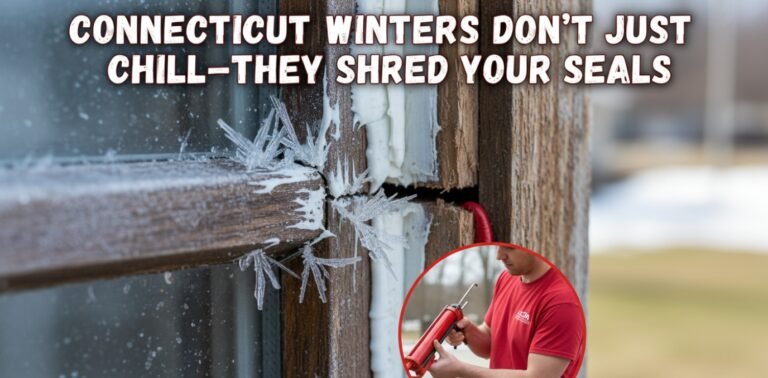

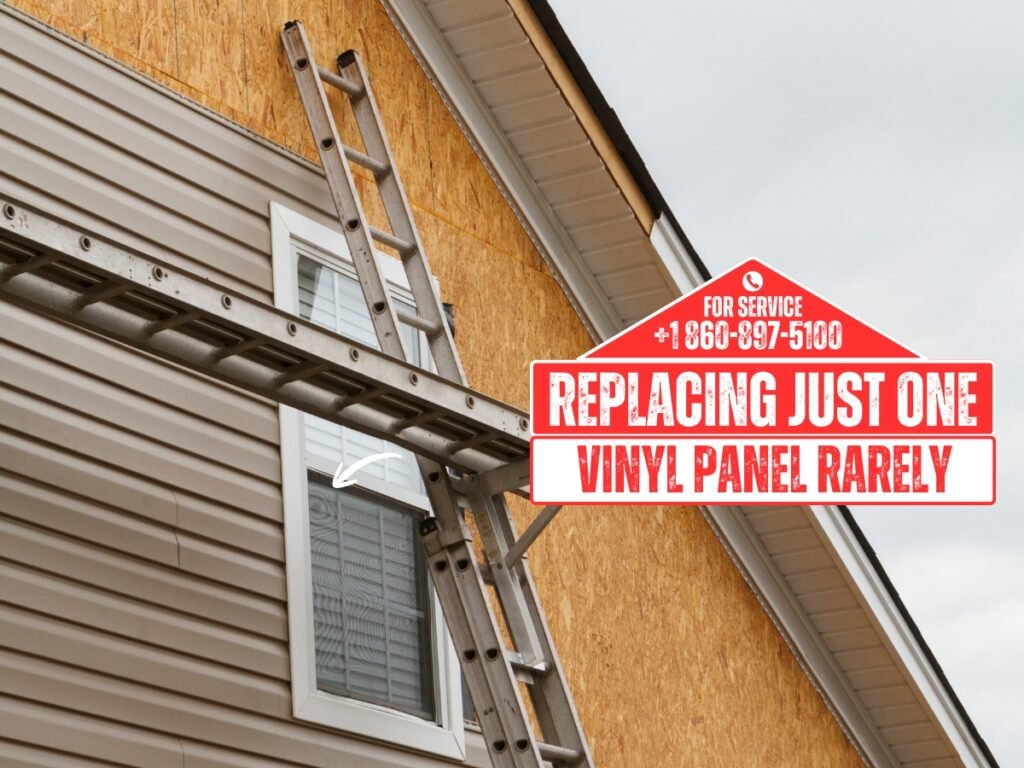
At first glance, the solution seems obvious.
One vinyl siding panel is cracked, warped, or loose — so you replace that one panel. Quick fix. Minimal cost. Problem solved.
Except in Waterbury, CT, it almost never is.
Homeowners across Waterbury, especially in older neighborhoods near Atwood Ave, often find that replacing a single vinyl panel doesn’t stop the problem. In many cases, it actually reveals deeper issues that were already developing behind the siding system.
At LCM Services LLC, this is one of the most common situations we encounter: a home with a recently replaced vinyl panel — and ongoing siding, moisture, or structural concerns that replacement alone could never solve.
The reason isn’t poor materials.
It’s how vinyl siding systems actually work — and how Waterbury homes age.
The Big Misconception: Vinyl Siding Works in Isolation
Vinyl siding doesn’t function panel by panel.
It works as a connected system designed to:
- Expand and contract together
- Shed water as a unit
- Maintain airflow behind the panels
- Protect the wall assembly beneath
When you replace just one panel, you’re inserting a new component into an aging system that may already be stressed, misaligned, or compromised.
That mismatch is where problems begin.
Why Waterbury Homes Are Especially Affected
Replacing a single vinyl panel fails more often in Waterbury than many homeowners expect — and local conditions play a major role.
Local Factors That Complicate Vinyl Siding Repairs
❄️ Freeze–thaw cycles that stress seams and fasteners
🌧️ Wind-driven rain that finds weak transitions
🌬️ Strong seasonal temperature swings
🏠 Older homes with uneven wall planes
Many Waterbury homes were not originally designed for vinyl siding. Over time, siding was added, modified, or repaired without fully rebuilding the wall system underneath.
Replacing one panel doesn’t reset that system — it exposes it.
Expansion and Contraction: The Silent Repair Killer
Vinyl siding expands in heat and contracts in cold. This movement is normal — if the siding was installed correctly and allowed to move as a unit.
When one new panel is installed into an older system:
- Nail spacing may differ
- Expansion gaps may not align
- Locking edges may not match wear patterns
What Happens Next
- The new panel moves differently
- Adjacent panels absorb extra stress
- Seams loosen or separate
- Warping appears elsewhere
In Waterbury’s climate, these issues often show up within one or two seasons.
Color Match Isn’t the Only Problem — Aging Is
Homeowners often focus on color mismatch when replacing a single vinyl panel.
But the bigger issue is material aging.
Older vinyl panels have:
- Become more brittle
- Lost flexibility
- Been exposed to UV degradation
- Shifted due to settling and movement
A new panel is stronger and more flexible — which sounds good, until it begins pulling against older panels that can’t move the same way.
This imbalance causes stress throughout the siding run.
Moisture Doesn’t Respect Panel Boundaries
One of the most dangerous assumptions homeowners make is that siding damage is isolated.
It rarely is.
When a vinyl panel is damaged, it often means:
- Water has already entered the wall system
- House wrap may be compromised
- Flashing could be failing nearby
- Sheathing may already be damp
Replacing the visible panel doesn’t address what’s happening behind it.
At LCM Services LLC, inspections frequently reveal moisture migration extending well beyond the replaced panel — sometimes several feet in either direction.
Why Single-Panel Repairs Often Lead to Repeat Failures
Homeowners are often frustrated when another panel fails shortly after a repair.
This happens because:
- The underlying issue wasn’t corrected
- Stress was redistributed to nearby panels
- Moisture continued moving behind the siding
- Fasteners loosened in adjacent sections
Replacing one panel treats the symptom, not the system.
Older Waterbury Homes Add Structural Challenges
Many Waterbury homes have:
- Settled framing
- Slightly bowed walls
- Multiple exterior renovations over decades
Vinyl siding doesn’t perform well over uneven surfaces unless the wall is properly prepared.
When a single panel is replaced on a wall that isn’t flat:
- Locking edges don’t seat correctly
- Panels flex under wind load
- Gaps open at seams
The repair looks fine initially — then slowly fails.
Why Wind and Storms Expose Weak Repairs
Waterbury storms don’t just bring rain — they bring wind-driven pressure.
That pressure:
- Tests locking mechanisms
- Pulls at fasteners
- Forces water into weak transitions
A single-panel replacement often becomes the weakest link in the siding system, especially if surrounding panels are already stressed.
Energy Efficiency Problems You Don’t See
Vinyl siding plays a role in managing airflow around your home.
When a panel is replaced without addressing:
- Insulation alignment
- Air sealing
- Drainage pathways
…drafts and energy loss can increase.
Many homeowners notice higher heating or cooling costs after siding repairs — without realizing the connection.
When Replacing One Panel Does Make Sense
To be fair, single-panel replacement can work when:
- Damage is purely cosmetic
- The siding system is relatively new
- There is no moisture intrusion
- Wall preparation is intact
But without professional evaluation, it’s impossible to know whether those conditions exist.
That’s why experienced contractors recommend assessment before repair — not after failure.
Why Professional Evaluation Changes the Outcome
A proper siding evaluation looks beyond the damaged panel.
It examines:
- Moisture behavior
- Wall condition
- Fastener stress patterns
- System compatibility
At LCM Services LLC, the goal isn’t to sell unnecessary replacement — it’s to prevent repeat repairs and escalating damage.
Repair vs Section Replacement vs Full Replacement
In many Waterbury homes, better solutions include:
- Replacing an entire siding section
- Addressing flashing and drainage
- Upgrading house wrap
- Correcting wall irregularities
These approaches cost more upfront — but save significantly over time.
The Cost of Replacing One Panel Over and Over
Homeowners often try to save money with minimal repairs.
But repeated single-panel replacements can lead to:
- Multiple service calls
- Interior wall repairs
- Moisture remediation
- Escalation to full replacement
What feels economical at first often becomes the most expensive path.
Why Local Experience Matters
Waterbury homes have unique characteristics:
- Construction eras
- Renovation patterns
- Climate exposure
A siding repair that works elsewhere may fail here.
Local experience is what prevents trial-and-error repairs.
Final Thoughts
Replacing one vinyl panel feels like the logical fix — but in most Waterbury homes, it’s only a temporary illusion of progress.
Vinyl siding works as a system.
Moisture moves behind surfaces.
Stress spreads to surrounding panels.
Without understanding the bigger picture, small repairs often lead to bigger problems.
The smartest approach isn’t replacing what you see — it’s understanding why it failed in the first place.
FAQs
Yes, but it often fails if underlying system issues aren’t addressed.
Because new vinyl moves differently than aged siding around it.
No — moisture often travels behind multiple panels.
Professional inspection is the only reliable way to know.
In many Waterbury homes, yes — it restores system balance.