

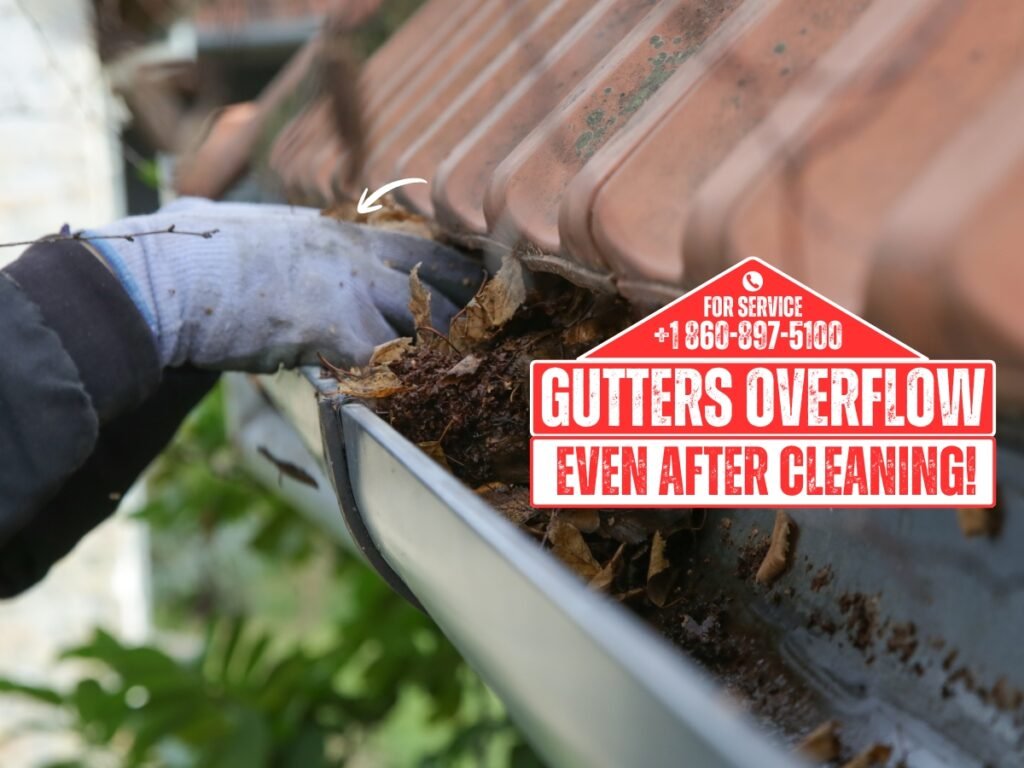
You had your gutters cleaned.
Leaves were removed.
Downspouts looked clear.
Then the next heavy rain hits in Waterbury — and water still pours over the sides.
It’s one of the most confusing and frustrating problems homeowners face. Many assume the cleaning wasn’t done properly, but in reality, gutter overflow after cleaning is extremely common, especially in older Connecticut homes.
At LCM Services LLC, we regularly inspect properties where homeowners say, “But the gutters were just cleaned!” The truth is, cleaning removes debris — it doesn’t fix structural or system problems that may be causing water to back up.
Let’s break down the real reasons this happens and why it’s so common in Waterbury.
First: What Gutter Cleaning Actually Does
Standard gutter cleaning typically removes:
- Leaves
- Twigs
- Dirt buildup
- Roof granules
- Surface debris from downspouts
This restores basic water flow — if the system itself is properly designed and in good condition.
But many overflow issues come from design, slope, damage, or hidden blockages, not just debris.
Waterbury’s Climate Makes Gutters Work Harder
Homes in Waterbury deal with:
- Heavy autumn leaf drop 🍂
- Snow accumulation
- Ice dams in winter
- Freeze–thaw expansion
- Sudden heavy rainstorms
This constant cycle stresses gutter systems year after year. Even a system that looks clean can struggle to handle the volume of water.
Problem #1: Improper Gutter Pitch
Gutters must be slightly sloped toward the downspouts. If they aren’t:
- Water pools in sections
- Flow slows down
- Backups occur during heavy rain
Over time, fasteners loosen and sections sag. A cleaned gutter that holds standing water is still a failing gutter.
Signs of pitch problems:
| Sign | What It Means |
| Water sitting after rain | Improper slope |
| Rust spots | Water pooling |
| Overflow at one section | Uneven pitch |
Cleaning doesn’t correct pitch — only adjustment or reinstallation does.
Problem #2: Downspout Blockages Underground
Many Waterbury homes have downspouts connected to underground drainage lines.
These lines can clog with:
- Roots
- Soil
- Debris
- Ice damage
From the outside, the downspout looks clear. But water hits the blockage underground and backs up — causing gutters to overflow at the roofline.
This is one of the most common hidden causes we find at LCM Services LLC.
Problem #3: Gutters Are Too Small
Older homes may have:
- 4-inch gutters instead of modern 5-inch systems
- Limited downspouts
- Designs not built for current rainfall patterns
During heavy Connecticut storms, these systems simply cannot carry enough water fast enough.
The result? Overflow — even when spotless.
Problem #4: Roof Runoff Is Overwhelming the System
Certain roof features increase water volume dramatically:
- Steep pitches
- Large roof valleys
- Metal roofing
- Extended roof planes
If gutter sizing wasn’t matched to roof design, water can overshoot or overwhelm the system.
Problem #5: Ice Damage Warping the Gutter
Winter ice buildup can:
- Bend gutter sections
- Loosen fasteners
- Pull gutters away from fascia
Even slight distortion changes how water flows. A gutter that looks fine from the ground may be misaligned enough to cause overflow.
Problem #6: Fascia Board Rot
Gutters attach to fascia boards. If wood behind the gutter rots:
- Fasteners loosen
- Gutters tilt outward
- Water bypasses the system
Cleaning won’t fix structural attachment failure.
Problem #7: Improper Drip Edge
A drip edge directs roof water into the gutter. If missing or installed incorrectly:
- Water runs behind the gutter
- It appears like overflow
- Moisture damages fascia and siding
Many older Waterbury homes lack modern drip edge installation.
Problem #8: Splash-Over from Heavy Rain
In intense storms, water coming off the roof can:
- Overshoot narrow gutters
- Hit too hard and bounce out
- Miss sections due to poor placement
Cleaning doesn’t change hydraulic capacity.
Problem #9: Gutter Seams and Joints Leaking
Older sectional gutters develop seam failures. Water leaks at joints and may look like overflow.
Seam failure worsens in freeze–thaw cycles common in Connecticut winters.
Problem #10: Downspout Placement Is Inadequate
Too few downspouts means:
- Water bottlenecks
- Flow slows
- Backups occur
A clean system still fails if water has nowhere to go fast enough.
Problem #11: Gutter Guards Can Create Overflow
Some guards:
- Restrict water entry
- Trap debris underneath
- Slow flow during heavy rain
The homeowner believes gutters are clean, but guards interfere with drainage.
Problem #12: Roof Granule Buildup
As shingles age, granules wash into gutters. They create sediment that:
- Slows water flow
- Blocks elbows
- Reduces capacity
Cleaning may remove loose debris but not compacted sediment in elbows.
Problem #13: Hidden Sag Between Hangers
Gutters may look straight but sag slightly between brackets. This causes pooling that leads to overflow.
Why This Is So Common in Waterbury Homes
Many homes here are decades old. Their gutter systems have:
- Been repaired repeatedly
- Shifted over time
- Been affected by winter ice
- Never been resized for modern rainfall patterns
Cleaning helps, but structural and hydraulic limitations remain.
When Overflow Becomes a Serious Problem
Consistent overflow can cause:
- Foundation erosion
- Basement moisture
- Siding damage
- Landscape destruction
- Ice hazards in winter
It’s more than a nuisance — it’s a home protection issue.
Why Professional Evaluation Matters
At LCM Services LLC, gutter issues are evaluated as a system, not just a cleaning task.
Inspection includes:
✔ Slope check
✔ Downspout testing
✔ Structural attachment review
✔ Capacity assessment
✔ Drainage evaluation
This identifies why water isn’t moving properly.
Cleaning vs. Correction
| Cleaning Fixes | Cleaning Does NOT Fix |
| Leaves | Improper pitch |
| Twigs | Undersized gutters |
| Surface debris | Underground blockages |
| Loose dirt | Structural warping |
Understanding this difference saves homeowners frustration.
How Proper Solutions Prevent Future Overflow
Solutions may include:
- Re-pitching gutters
- Adding downspouts
- Flushing underground drains
- Replacing warped sections
- Upgrading to larger gutters
These corrections address root causes.
Final Thoughts
If your gutters overflow after cleaning, the issue likely isn’t debris — it’s system performance.
Waterbury’s climate and older housing stock create conditions where gutters need more than maintenance. They need proper evaluation and adjustment.
Addressing the real cause protects your roof, walls, and foundation long-term.
FAQs
Cleaning removes debris but does not fix slope issues, blockages underground, or undersized gutter systems that restrict water flow.
Yes. If downspouts or underground drains are clogged, water backs up and spills over the gutter edges.
Often yes, because older systems may be undersized, damaged by ice, or improperly pitched.
Yes. Overflowing water can damage siding, foundations, landscaping, and cause basement moisture issues.
Solutions include re-pitching gutters, adding downspouts, clearing drainage lines, or upgrading gutter size.