
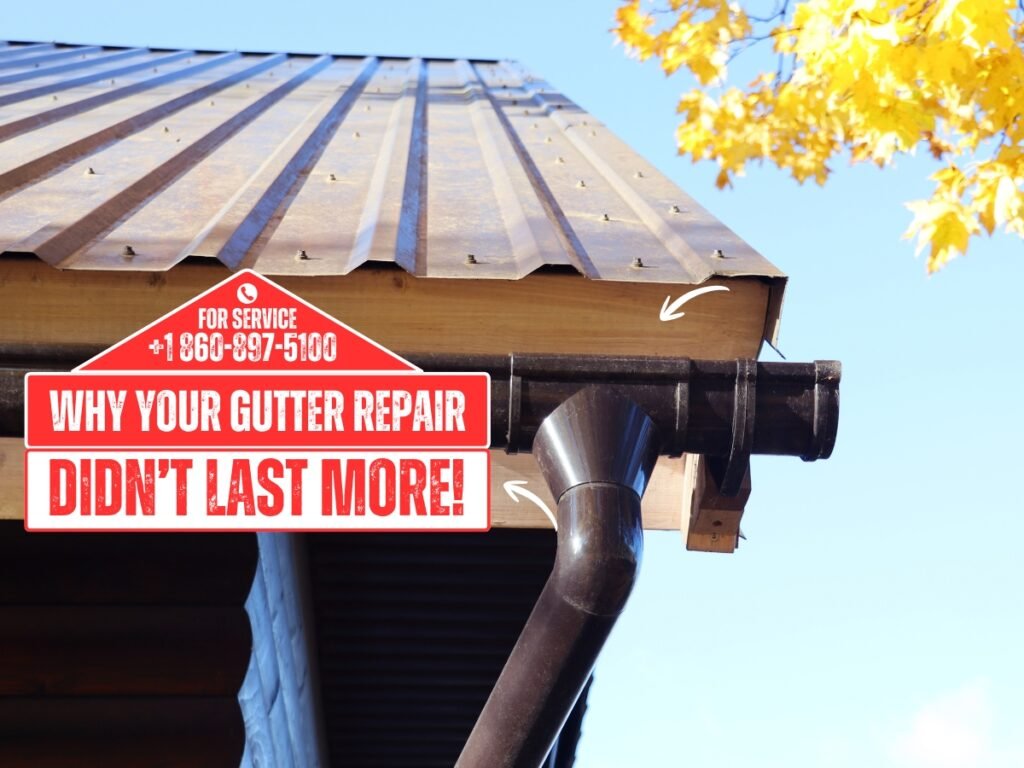
You paid for a gutter repair.
The leak stopped.
The sagging section was secured.
Then one year later — or sooner — the same issue comes back.
For many Waterbury homeowners, this cycle feels confusing and expensive. The repair seemed fine at first, but Connecticut weather has a way of exposing weaknesses fast.
At LCM Services LLC, we often evaluate homes where past gutter repairs failed prematurely. The issue usually isn’t just bad luck — it’s that the original repair didn’t address the real structural and environmental stressors that gutters face in this region.
Understanding why short-lived repairs happen helps homeowners invest in solutions that actually last.
Waterbury Weather Is Tough on Gutters
Gutters here endure:
❄️ Heavy snow loads
🧊 Ice buildup and expansion
🌧 Sudden heavy rainstorms
🍂 Leaf and debris accumulation
🌡 Freeze–thaw cycles
These forces repeat year after year. Any repair that doesn’t account for them may fail quickly.
Reason #1: The Repair Only Treated the Symptom
Many quick fixes focus on what’s visible:
- Sealing a seam leak
- Reattaching a loose section
- Patching a hole
But the cause may be:
- Improper pitch
- Weak fascia boards
- Undersized gutters
- Poor drainage design
If the root issue remains, water stress continues until failure returns.
Reason #2: Fascia Board Weakness Was Ignored
Gutters attach to fascia. If that wood is:
- Soft
- Rotted
- Moisture-damaged
Fasteners won’t hold long-term. Even if gutters look secure, the structure behind them is failing.
Reason #3: Connecticut Ice Expansion
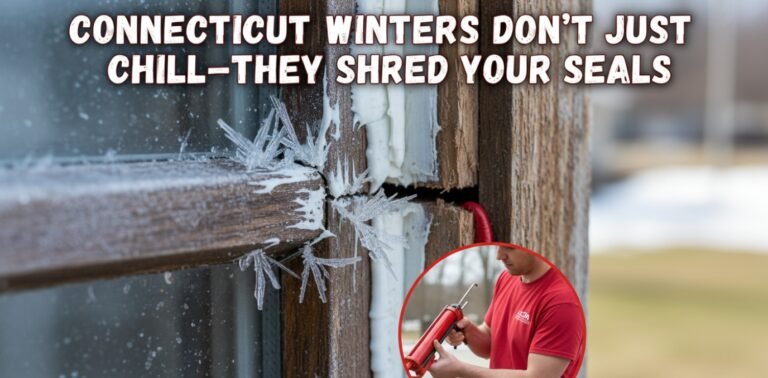
Water trapped in gutters freezes in winter. Ice expands, pushing joints apart and warping sections.
A repair that doesn’t allow proper drainage or slope adjustment leaves water sitting — setting up freeze damage.
Reason #4: Old Fasteners Were Reused
Temporary repairs sometimes reuse old screws or hangers.
But aged metal:
- Corrodes
- Weakens
- Loses grip
Under snow and ice weight, they fail again.
Reason #5: The Gutter System Is Undersized
Older Waterbury homes may have 4-inch gutters that can’t handle today’s heavier rain events.
Overflow stress forces water over edges, weakening attachments and seams.
A patch doesn’t increase capacity.
Reason #6: Poor Pitch Was Never Corrected
Gutters need slope toward downspouts. If not adjusted:
- Water pools
- Weight increases
- Sagging returns
Sealing leaks without re-pitching only delays failure.
Reason #7: Downspout Issues Remain
If downspouts are clogged or improperly routed:
- Water backs up
- Pressure builds in gutter sections
- Seams and joints separate
A gutter repair won’t last if water can’t exit efficiently.
Reason #8: Winter Snow Load Wasn’t Considered
Snow accumulation adds significant weight. Weak repairs collapse under winter stress.
Reason #9: Dependence on Temporary Sealants
While high-quality sealants have their place, they are often used as a “bandage” for structural gaps that actually require mechanical fastening or flashing. In the volatile Connecticut climate, caulk is the first point of failure.
- UV Degradation: Constant sun exposure causes sealants to lose their elasticity, leading to shrinking, cracking, and pulling away from the substrate.
- Thermal Expansion: Materials like aluminum gutters and wooden fascia expand and contract at different rates. Rigid sealant cannot bridge these shifting gaps indefinitely.
- Hydrostatic Pressure: When water pools against a bead of caulk rather than flowing over it, the moisture eventually finds a microscopic path behind the seal, rendering the repair useless.
- Structural Integrity: Sealants offer zero structural support. If a gutter is sagging, “more caulk” won’t stop the gravitational pull that is tearing the system away from your home.
Reason #10: Hidden Roof Drainage & Cascading Failures
Sometimes the gutter isn’t the primary antagonist—it’s the victim of poor roof dynamics. If the water isn’t delivered to the gutter correctly, even a brand-new system will fail.
- Drip Edge Deficiencies: Without a proper drip edge, water wicks backward via surface tension, rotting the fascia board behind the gutter.
- Concentrated Runoff: “Valley splashes” occur when two roof planes meet, sending a high-velocity stream of water that overshoots the gutter entirely or puts localized stress on a single seam.
- Capillary Action: Water can “climb” under shingles if they aren’t trimmed correctly, bypassing the gutter system and entering the soffit or interior walls.
Why This Happens Often in Waterbury Homes
Many houses here are decades old, with:
- Multiple past repairs
- Weather exposure
- Aging materials
Short-term fixes compound over time, weakening the system further.
The Difference Between Patch Repair and System Repair
| Patch Repair | System Repair |
| Seals leaks | Corrects slope |
| Reattaches sections | Strengthens fascia |
| Uses old hardware | Installs new fasteners |
| Temporary relief | Long-term performance |
The Long-Term Cost of Repeated Repairs
Short-lived repairs often lead to:
- Higher cumulative costs
- Hidden siding damage
- Foundation moisture
- Mold risks
Investing in a proper fix once can prevent multiple service calls.
How Professional Repairs Last Longer
At LCM Services LLC, durable gutter repair includes:
✔ Inspecting fascia integrity
✔ Re-pitching for proper flow
✔ Replacing weak hardware
✔ Checking downspout drainage
✔ Evaluating system capacity
This addresses why the failure happened — not just the visible issue.
When Replacement Is Smarter Than Repair
If a system has:
- Extensive corrosion
- Multiple sagging sections
- Repeated seam failures
Upgrading may be more cost-effective than patching.
Final Thoughts
If your gutter repair didn’t last a year, it’s not just bad luck. It’s likely the repair didn’t account for Waterbury’s weather stress and the system’s structural condition.
A properly evaluated and corrected gutter system can handle the region’s climate without repeated failure.
FAQs
Freeze–thaw cycles, snow load, and heavy rain stress systems beyond what quick fixes can handle.
Yes. Weak fascia won’t hold fasteners securely.
No. Structural alignment and drainage must also be corrected.
Recurring sagging, leaks, or overflow within a year suggests underlying issues remain.
When damage is widespread or structural integrity is compromised.